
Choosing lifting equipment for industry – which hoist or crane suits your work?
Choosing the right lifting equipment starts with the work the equipment will do. How heavy is the piece being lifted, where is it picked up and where is it moved? A crane suitable for serving one machine can be very different from the system needed for material handling in an entire production hall.
In this guide, we compare chain hoists, light cranes, jib cranes and overhead cranes. We also explain what information is worth collecting for dimensioning the lifting equipment and for the request for quotation.
Hoist or crane – what is the difference?
The hoist performs the actual lifting movement. For example, an electric chain hoist raises and lowers the load by means of a chain. A crane forms a larger whole, in which the hoist and the structures supporting it make it possible to handle the load within a certain working area.
Depending on the application, the same chain hoist can be installed at a fixed lifting point, on a trolley, on a jib or on an overhead crane. That is why the choice of hoist and crane structure should be considered together.
Which lifting equipment suits which application?
| Lifting need | Solution | Selection criteria |
|---|---|---|
| Lifting at one point | Fixed chain hoist | Load, lifting height and amount of use |
| Lifts at one workstation | Jib crane | Outreach, slewing area and mounting |
| Moves within an assembly area | Light crane system | Work area, ease of movement and travel method |
| Moving along a specific route | Monorail and hoist with trolley | Shape of the route and stopping points |
| Lifts over a large hall area | Overhead crane | Span, lifting capacity and severity of use |
The table helps narrow down the options. The final solution is dimensioned on the basis of the load, the structures and the actual use.
Electric chain hoist for repetitive lifts
An electric chain hoist is suitable for many kinds of lifting tasks in production, assembly and maintenance. In addition to the rated lifting capacity, the selection takes into account the lifting speed, lifting height, amount of use and the features needed for precise positioning of the load.
If the piece has to be moved sideways after lifting, a suitable trolley and runway or another crane structure is needed. The location of the control and the operator’s view of the load also affect how smoothly the work goes.
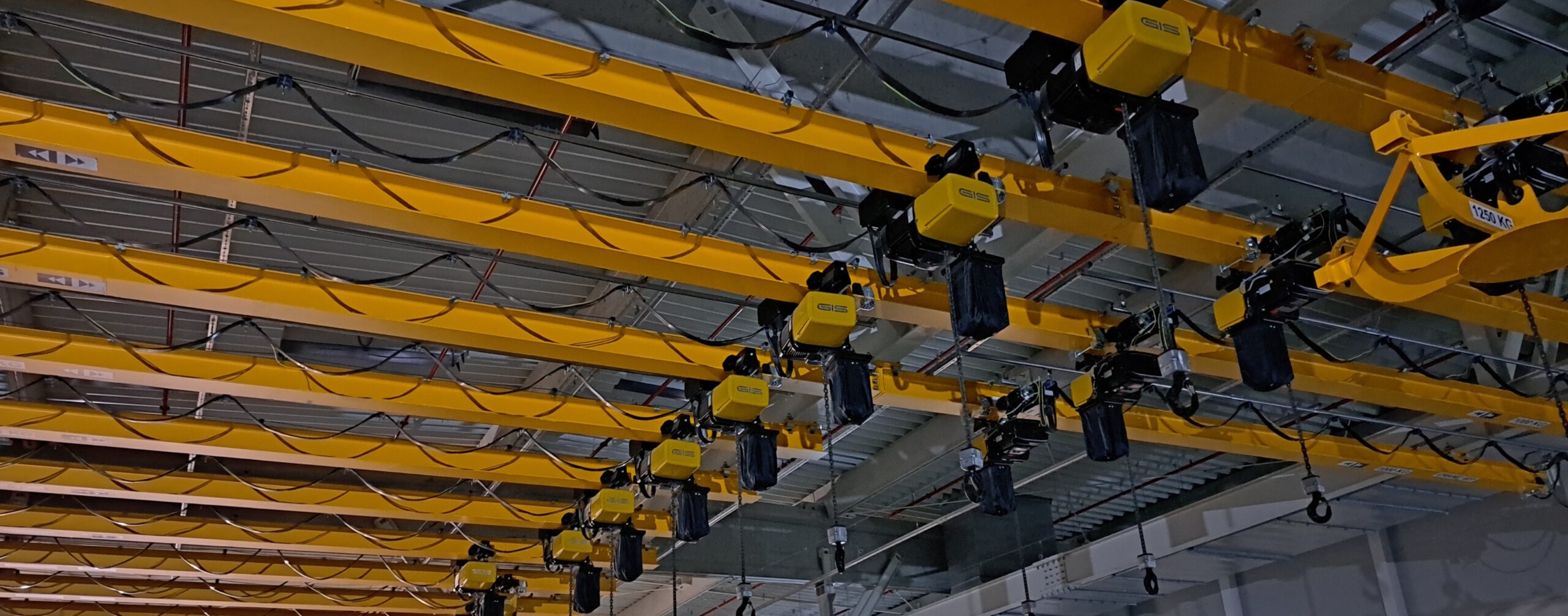
Tuotetekno’s range includes GIS GP electric chain hoists. The right hoist is chosen according to the requirements of the application.
Light crane for assembly and moves between workstations
A light crane system is a serious option when pieces are lifted and moved repeatedly within a limited production area. Typical applications are assembly lines, machine shops and workstations where the lifting equipment is used as part of the daily work cycle.
When choosing, look at the whole travel distance: does the crane cover both the pick-up point of the piece and its installation or drop-off point? And are there machines, shelves or other obstacles in the area that restrict movement?
With the GIS KB light crane system various runway and bridge solutions can be implemented. The choice of structure, support spacing and load determine what kind of system suits the site.
Jib crane to serve a machine or workbench
A jib crane is suitable for local lifting work, for example loading a machine tool or moving pieces between a workbench and a pallet.
The jib of a pillar jib crane is supported by its own pillar. A wall-mounted jib crane is attached to a suitable load-bearing structure. In addition to lifting capacity, the selection considers the outreach of the jib, the available height and the required slewing area.
The mounting method is an essential part of the design. The suitability of the floor, foundation or other supporting structure is checked before implementation. Take a look at Tuotetekno’s jib cranes.
Overhead crane for a large working area
An overhead crane is a natural choice when loads are handled over a large hall area. Its selection emphasises lifting capacity, span, runway length, lifting height and the number of work cycles.
The choice between a light crane and an overhead crane is not decided by the weight of the load alone. Travel distances, frequency of use, desired travel speeds and the building’s structures also play a part. A light crane can also be an overhead (bridge) crane in structure; in practice, the comparison is often between a profile system and a heavier crane structure.
Take a look at our overhead crane solutions when you need a crane for material handling in a hall or production area.
In low spaces, the available hook height is decisive
The height of the hall alone does not tell how high the load can be lifted. The crane structures, the hoist and the lifting accessory take up part of the available space. The dimensions of the piece itself also affect the required lifting height.
If space is limited, the suitability of a low-headroom hoist or a raised bridge solution should be investigated at the very beginning of the design. At the same time, check that the load can be lifted over obstacles and moved along the entire required route.
What information is needed for a crane request for quotation?
A good request for quotation describes not only the equipment but also the need for it. Collect the following information where possible:
- Load: the maximum mass to be lifted, the dimensions of the piece and the lifting accessory to be used.
- Movements: where the load is lifted from, where it is moved and how it is lowered into place.
- Space dimensions: lifting height, working area, outreach or span, and obstacles.
- Amount of use: lifts per hour, daily operating time and typical loads.
- Environment: indoor or outdoor use, temperature, humidity, dust and other special conditions.
- Structures: available mounting points and information about the floor and load-bearing structures.
- Scope of delivery: design, installation, commissioning, operator training and maintenance services.
A floor plan, photos and a short description of the work stage help in assessing the options. You do not need to know the exact crane model in advance.
Also consider servicing and usability
The purchase price of the lifting equipment is one part of the whole. Daily use is also affected by controllability, serviceability, availability of spare parts and how well the solution fits the production work stages.
The needs for servicing, inspections and possible later changes should be addressed already at the time of purchase. Tuotetekno’s services cover the design, installation, servicing and inspection of lifting equipment.
Ask for help choosing lifting equipment
Tuotetekno has served customers of lifting and handling equipment since 1992. We help you choose the hoist, crane structure and control solution according to the application.
Send us the load details, the required movements and the dimensions of the site. Together we will find out what kind of lifting equipment suits your work.
Contact us and request a quote.
GIS GP ketjusähkönostimet – Tehokas ja kestävä nostoratkaisu jopa 8 000 kg saakka


