The duty cycle (ED%) and mechanism class of an electric chain hoist are important ratings that help describe the hoist’s performance and suitability for different conditions and uses.
1. ED% (duty cycle, %):
ED% (or duty cycle percentage) tells how long the hoist can operate in relation to its rest time. It defines the hoist’s utilisation rate and its ability to withstand repeated loading without overheating or being damaged.
For example, the ED% can be 25%, 40% or 60%, which means that the hoist can work for that percentage of the time before it needs rest. If the ED% is 25%, the hoist can work 25% of the time and rest 75% of the time.
A high ED% means that the hoist is designed to withstand continuous use without long breaks.
2. Mechanism class:
The mechanism class indicates the hoist’s designed utilisation and load spectrum. It defines how often and how heavy loads the hoist can lift without its structure or motor being damaged.
The mechanism class can be, for example:
M3 (light duty): This class means that the hoist is intended for light and infrequent use, for example when the loads lifted are not large and the work is not continuous.
M5 (medium duty): The hoist is designed for normal work where loads are average and use is more regular.
M7 (heavy duty): This class means that the hoist is designed for demanding and heavier tasks where it is frequently loaded and the intensity of use is high.
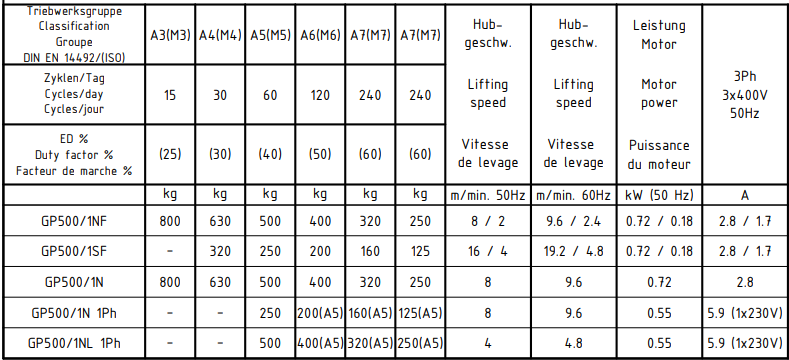
The table clearly shows how the load capacity decreases in inverse proportion to the increase in ED%. Simply put, lighter use gives a longer service life.


