
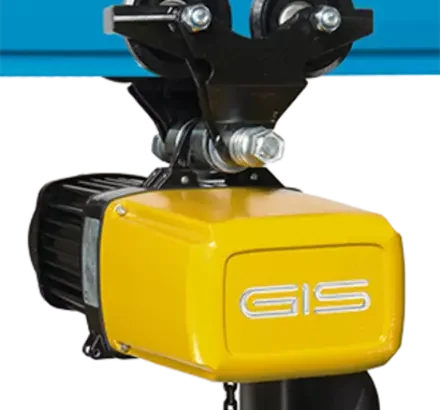
The electric chain hoist is one of the most common lifting devices in industry. It is suitable both for occasional maintenance lifts and for continuous production use where loads are lifted and lowered repeatedly. A correctly chosen electric chain hoist improves the flow of work, reduces manual load handling and enables controlled lifts in a variety of working environments.
However, when choosing an electric chain hoist, looking at the lifting capacity alone is not enough. Lifting height, lifting speed, frequency of use, environmental conditions and the mounting method all affect which solution works best.
In this guide, we go through the operating principle of the electric chain hoist, the most important selection criteria, different applications and the features worth paying attention to when buying a hoist.
What is an electric chain hoist and how does it work?
An electric chain hoist is a motor-driven lifting device in which the load is lifted and lowered by means of a steel load chain. The hoist’s electric motor drives a chain sprocket through a gearbox, which moves the load chain and the load hook attached to it.
The main parts of the hoist are the electric motor, the gearbox, the load chain carrying the load, the load hook, the brake, and the control and safety devices.
An electric chain hoist can be used as a fixed installation or as part of a moving lifting system. The hoist can be suspended, for example, from an overhead crane, a jib crane, a light crane system or a trolley running on a beam.
The advantages of an electric chain hoist are its compact structure, controlled lifting movement and the possibility to adapt the hoist to different workstations. Especially for short and medium lifting distances, a chain hoist is often a practical alternative to a wire rope hoist.
Choosing an electric chain hoist – the seven most important features
1. Lifting capacity and load weight
The rated load of the hoist must be at least equal to the total load to be lifted. In addition to the piece itself, the total load must include any lifting accessories, such as lifting beams, clamps and lifting magnets.
Common industrial lifting capacities include, for example:
- 125–250 kg: light assembly and maintenance work
- 500 kg: workstation lifts and smaller machine parts
- 1000 kg: machine shops, maintenance and production lines
- 2000 kg: heavier pieces and industrial material handling
- 3200–5000 kg: more demanding production and installation lifts
These are examples of applications, not fixed dimensioning limits. The hoist is always selected according to the actual load and operating conditions.
Simply choosing a larger lifting capacity does not automatically mean a longer service life either. The hoist’s duty class and amount of use are at least as important.
2. Lifting height and available space
Lifting height means the vertical travel available to the load hook.
When determining a suitable lifting height, you must take into account the distance between the floor and the hoist, the height of the load, the space required by lifting accessories and the desired highest and lowest hook positions.
A particularly important dimension is the headroom of the hoist, i.e. the space needed between the suspension point and the load hook when it is in its highest operating position.
If the clear height of the building is low, a low-headroom electric chain hoist may be needed. In this case, the structure of the hoist and trolley is designed so that the load hook can get as close as possible to the supporting beam.
3. Lifting speed and load control
Lifting speed affects both the precision of work and the efficiency of production.
A slower lifting speed makes it easier to position the load precisely, for example in machine installation and assembly work. A higher speed, on the other hand, shortens the time spent lifting when lifting distances are long.
Electric chain hoists are available with one or two speeds and with infinitely variable lifting speed.
In a two-speed hoist, the faster movement is suitable for the actual lift and the slower one for precise positioning of the load. A hoist controlled by a frequency inverter allows the lifting speed to be adjusted as needed.
When the load is handled repeatedly and precisely, control of the lifting speed can have a significant impact on how smoothly the work goes.
4. Duty class and hoist loading
One of the most important but often overlooked features is the hoist’s duty class.
Two electric chain hoists with the same lifting capacity can be suited to very different uses. One may be intended for occasional maintenance lifts, while the other is dimensioned for repetitive production use.
The duty class is determined by looking at, among other things, the load spectrum, operating time, number of lifts and the designed service life.
Hoist classification can use, for example, FEM or ISO classes. However, the duty class must always be checked from the technical data of the hoist in question.
If the hoist is dimensioned for too light a duty, the result may be premature wear and unexpected maintenance needs.
That is why you should tell the hoist supplier not only the maximum load but also the typical load weight, the number of lifts and the lifting distance.
5. Mounting method – fixed hoist or moving lifting system?
An electric chain hoist can be installed at a fixed suspension point or combined with a trolley, allowing the load to be moved horizontally as well.
A fixed electric chain hoist is suitable for a workstation where the load is lifted mainly at the same point.
A chain hoist with a push trolley allows the load to be moved along the beam by hand.
A motorised trolley is suitable for repeated or longer horizontal moves.
A chain hoist installed on a jib crane serves, for example, a single machine or assembly point.
A chain hoist installed on a light crane system or overhead crane allows the load to be moved over a wider working area.
When choosing a hoist, it is therefore useful to look at the whole load handling process and not just the vertical lift.
6. Operating environment and protection class
The conditions of the operating environment have a significant effect on the reliability of the hoist.
The requirements for a hoist in an ordinary dry industrial hall may differ from those in a dusty production area, outdoors or in a humid process environment.
When selecting a hoist, the effects of dust, humidity, temperature, corrosion and any chemicals must be assessed, for example.
The IP protection class indicates how well the enclosure of an electrical device protects against solid foreign objects and water. For example, IP65 means a dust-tight enclosure and protection against water jets.
However, IP65 alone does not guarantee that the hoist is suitable for all outdoor or corrosive conditions.
In potentially explosive atmospheres, a hoist suitable for the ATEX zone classification and operating conditions in question is required.
7. Serviceability and life cycle costs
The purchase price of an electric chain hoist is only one part of its total costs.
Over the service life of the hoist, costs arise from, among other things, periodic inspections, maintenance, spare parts and possible production downtime.
In a long-lasting hoist, the durability of the structure, availability of spare parts, serviceability and the hoist’s suitability for the actual amount of use are emphasised.
For example, an easily serviceable gearbox and brake design can reduce the working time needed for maintenance.
That is why, when comparing different hoist options, it is worth assessing not only the purchase price but also their service life and maintenance requirements.
Electric chain hoist or wire rope hoist?
Electric chain hoists and wire rope hoists are partly suited to the same applications, but there are differences in their characteristics.
The strengths of the electric chain hoist are usually its compact structure, simple installation and suitability for workstation lifts.
A wire rope hoist, on the other hand, may be more appropriate for particularly large lifting capacities, long lifting distances or demanding crane applications.
However, the choice should not be made on the basis of the weight to be lifted alone. Both types of hoist are available in models designed for different duty classes and conditions.
Which electric chain hoist suits which application?
| Application | Key selection criteria |
|---|---|
| Machine shop and metal industry | Lifting capacity, duty class, lifting speed |
| Assembly workstation | Precise positioning, ergonomic control, headroom |
| Maintenance | Ease of installation, reliability, serviceability |
| Warehouse and logistics | Lifting frequency, trolley, lifting height |
| Food industry | Cleanability, corrosion resistance, environmental requirements |
| Outdoor use | IP protection, temperature, corrosive conditions |
| Potentially explosive atmosphere | ATEX suitability and zone classification |
What should you expect from a high-quality electric chain hoist?
A high-quality electric chain hoist can be recognised above all by the fact that its structure, duty class and safety features match the intended application.
When comparing hoists, pay particular attention to the structure of the load chain, the operating principle of the brake, the durability of the gearbox, limit switches, overload protection and how easy it is to service.
One example of a solution designed for demanding industrial use is the Swiss GIS GP electric chain hoist.
The design of the GIS GP series focuses on mechanical durability and serviceability. Its features include, among others:
- IP65-protected aluminium housing
- Enclosed, lifetime-lubricated gearbox
- Manganese-phosphated profile steel load chain
- Wear-resistant DC spring-applied brake
- Adjustable limit switches for the lifting movement
- Dry-running slip clutch
- 42 V low-voltage control in applicable models
- Modular structure that makes servicing easier
- Three-year manufacturer’s warranty in accordance with the manufacturer’s warranty terms
The design of GIS GP hoists also emphasises a simple structure without unnecessary control electronics. This is one way to reduce potential points of failure in demanding industrial use.
Low-headroom, frequency inverter controlled, corrosion-resistant and ATEX-protected solutions are also available for different applications.
The most important thing, however, is always to choose the hoist based on the actual need, because even a technically high-quality hoist does not replace correct dimensioning.
Safety and inspections of electric chain hoists
An electric chain hoist is a load-lifting machine whose safe use requires proper installation, compliance with the operating instructions and maintenance.
The key product standards for electric chain hoists include EN 14492-2, which covers power-driven hoists.
When commissioning the hoist, it must be ensured, among other things, that the suspension structure has sufficient load-bearing capacity, the hoist is correctly installed, the safety devices work and the operating environment is suitable.
During use, the hoist must be properly inspected and serviced. In Finland, the inspection obligations for work equipment are determined by, among other things, Government Decree 403/2008.
The inspection procedure and the competence of the inspector depend on the type of device, the installation and the applicable requirements. Maintenance and inspections of the hoist must be carried out taking the manufacturer’s instructions into account.
Frequently asked questions about electric chain hoists
How much does an electric chain hoist cost?
The price of an electric chain hoist depends on the lifting capacity, lifting height, duty class, lifting speed, control method and any accessories. The trolley and installation also affect the total price. It is best to request an exact price for a solution dimensioned according to your needs.
What is the difference between a “sähköketjunostin” and a “ketjusähkönostin”?
In Finnish, “sähköketjunostin” and “ketjusähkönostin” mean practically the same device: an electric chain hoist driven by an electric motor. The term “sähkönostin” (electric hoist) is also used, but in addition to a chain hoist it can also mean, for example, a wire rope hoist.
Is a 500 kg electric chain hoist enough for workstation use?
A 500 kg electric chain hoist is suitable for many workstation lifts, as long as the mass of the total load does not exceed the rated load of the hoist. In addition, the hoist’s duty class, lifting height and structures must suit the application.
Can an electric chain hoist be used outdoors?
Yes, if the hoist is designed for the outdoor conditions in question. In addition to the enclosure class of the hoist, corrosion, temperature, humidity and the operating limits set by the manufacturer must be taken into account.
How often must an electric chain hoist be inspected?
The inspection interval is determined by the applicable regulations, the type of device, the manufacturer’s instructions and the operating conditions. Many industrial hoist applications use an annual documented inspection. Demanding conditions may require a more frequent inspection and maintenance programme.
Should you choose a single-speed or two-speed electric chain hoist?
A two-speed hoist is often a good choice if the load needs to be both lifted efficiently and positioned precisely. A single-speed hoist may be enough for simple lifting tasks. For demanding positioning, an infinitely variable lifting speed can be considered.
A correctly dimensioned electric chain hoist serves for a long time
The choice of an electric chain hoist should start with an assessment of the application. In addition to the load to be lifted, the number of lifts, the lifting height, the operating environment and the need to move the load must be taken into account.
A high-quality and correctly dimensioned electric chain hoist can serve in industry for a long time when it is installed, used and maintained properly.
Tuotetekno Oy supplies electric chain hoists and complete lifting solutions for a wide range of industrial needs. The range includes Swiss GIS electric chain hoists and compatible trolleys, controls and crane systems.
We help you choose the hoist based on the load, the amount of use and the installation environment.
Do you need an electric chain hoist for a workstation, production line or maintenance? Contact Tuotetekno and ask for a solution that suits your application.
GIS GP ketjusähkönostimet – Tehokas ja kestävä nostoratkaisu jopa 8 000 kg saakka


