

At industrial workstations, all kinds of pieces are lifted, moved, held and handled every day. Tasks can range from handling small components to installing machine parts weighing hundreds of kilos. Even if a single lift does not feel particularly heavy, repeated lifts, awkward working postures and holding pieces strain the worker over the working day.
Workstation cranes offer a safe, ergonomic and efficient solution for material handling. A properly designed lifting solution reduces physical strain, makes work easier and enables controlled handling of loads. At the same time, the flow, quality and productivity of work can be improved.
Workstation cranes are widely used, for example, in machine shops, on assembly lines, in maintenance, in warehouses and in various production and service facilities.
What are workstation cranes?
Workstation cranes are lifting devices and crane systems designed to serve a single workstation, production cell or limited working area.
Unlike large overhead cranes serving the entire production hall, workstation cranes are placed close to the actual task. This way, the lifting device is easily available to the worker exactly when it is needed.
Workstation cranes include, for example:
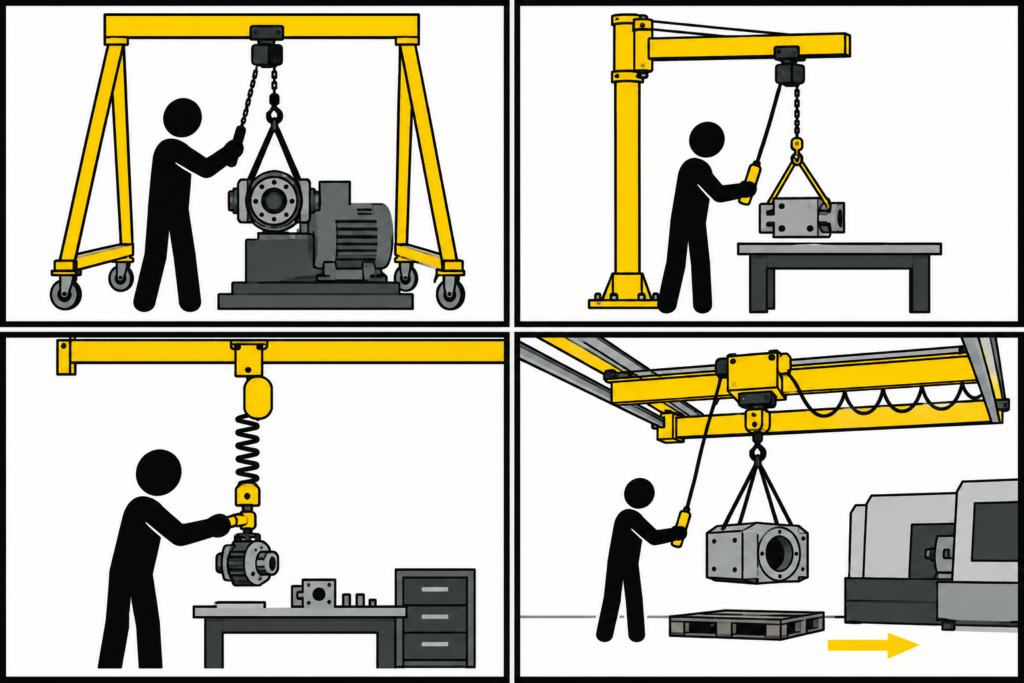
- Jib cranes, which allow loads to be lifted and moved within the working area of the jib.
- Light cranes and light crane systems, which allow loads to be moved easily and in a controlled way between workstations.
- Mobile cranes, which are suitable for changing work environments and temporary lifting needs.
- Aluminium gantry cranes, which offer a flexible lifting solution for maintenance and installation work, for example.
- Manipulators and load balancers, which make it easier to handle, hold, orient and precisely position pieces.
Depending on the purpose, the crane structure can be combined with, for example, an electric chain hoist, a pneumatic hoist, a load balancer or another suitable lifting device.
Where are workstation cranes used?
The applications of workstation cranes range from individual installation points to large production entities. The right solution is determined by the pieces to be lifted, the working area and the requirements of the task.
Machine shops and the metal industry
Machine shops often handle heavy, awkwardly shaped or hard-to-grip pieces. A workstation crane can be used to lift workpieces into machines, move them from one work stage to another and handle finished products.
Typical applications include loading CNC machines, welding tables, lathes, machining centres and assembly points.
A workstation crane reduces manual lifting and allows pieces to be positioned precisely without unnecessary physical effort.
Assembly and production lines
In assembly work, the same lifts and moves can be made dozens or even hundreds of times during a shift.
A workstation crane can be used, for example, to lift motors, gearboxes, frame structures or other components to the assembly point and hold them in a controlled way at the right height during installation.
Easily movable crane systems and load balancers are particularly suitable for work stages where pieces are handled repeatedly and their positioning requires precision.
Maintenance and service work
In maintenance, lifting needs may be occasional, but the pieces handled are often heavy or hard to reach.
Workstation cranes are used, for example, for removing, lifting and installing pumps, motors, gearboxes and other machine parts.
A fixed jib crane can serve a specific service point, while a mobile crane or aluminium gantry crane can be taken wherever the lifting need happens to be.
Warehouses, packing and logistics
In warehouse and packing work, lifting devices can be used to move products onto pallets, workbenches, into packaging or onto production lines.
A lifting device can also be used to handle large or hard-to-grip products that would be strenuous or unsafe to move by hand.
An appropriate lifting accessory can improve the controllability of handling and reduce the risks to both workers and products.
Ergonomics – less strain, better working
Ergonomics is one of the most important benefits of workstation cranes.
The physical strain of work does not depend only on the weight of the piece being lifted. It is also affected by the number of lifts, the size of the piece, the reach distance, the working posture and the force needed to handle the load.
For example, repeatedly lifting a relatively light piece from floor level onto a workbench can put considerable strain on the back, shoulders and upper limbs. Similarly, holding or precisely positioning a heavy piece can cause strong muscle tension even if there is little actual lifting movement.
With a workstation crane, the weight of the load is transferred from the worker’s body to the lifting device.
Among other things, this makes it possible to:
- Reduce the physical strain on the back, shoulders and upper limbs.
- Reduce bending, reaching and awkward working postures.
- Handle loads at a working height that suits the worker.
- Hold and position heavy pieces without constant use of muscle power.
- Lighten repetitive work movements and make work smoother.
Easily movable crane systems, manipulators and load balancers in particular can improve ergonomics in tasks where pieces are constantly moved and positioned.
However, good ergonomics does not only mean eliminating heavy lifts. Repeated handling of light pieces should also be designed so that unnecessary strain on the worker is reduced.
Wellbeing and coping at work
Physically demanding work affects how workers cope both during the working day and in the long term.
Repeated heavy lifts, awkward working postures and constant muscle tension can cause fatigue and increase the risk of musculoskeletal symptoms.
When lifting work is lightened with appropriate aids, the worker can concentrate on the actual task instead of lifting and holding the piece.
Using workstation cranes can promote wellbeing at work in many ways:
Less physical fatigue. Lightening heavy and repeated lifts reduces the strain that builds up during the working day.
Better coping at work. When tasks can be performed without unnecessary use of force, the physical demands of the work are easier to manage.
Taking individual differences into account. Workers’ physical characteristics and capacities vary. Lifting devices can make it possible for different workers to perform the same task safely.
Supporting work ability. An ergonomically designed work environment helps prevent harmful strain and supports maintaining work ability at different stages of a career.
Meaningful work. When work equipment supports the work and does not cause extra strain, working can feel smoother and more under control.
A workstation crane is therefore much more than just a device for lifting loads. It is also an investment in employee wellbeing and in developing the work environment.
Occupational safety as part of the lifting solution
An important task of workstation cranes is to reduce the hazards associated with manual handling.
Lifting heavy or awkward pieces by hand can cause, for example, sudden strains, loss of balance, crushing injuries or hazardous situations related to the load falling.
A correctly chosen lifting device allows the load to be lifted, lowered and moved in a controlled way.
However, lifting safety is not based on the use of the crane alone. A safe whole requires that the lifting device, its mounting structures, lifting accessories and operating environment are suitable for the intended task.
Particular attention must be paid to securing the load reliably, keeping the lifting route clear, preventing crushing hazards and giving workers sufficient induction.
Correct dimensioning of the lifting device, proper use, maintenance and the required inspections are an essential part of safe lifting work.
Workstation cranes can also make production more efficient
In addition to ergonomics and safety, workstation cranes can improve the flow of production.
When the lifting device is located right at the workstation, handling loads does not necessarily require waiting for a separate forklift, a large hall crane or another worker.
With a suitable lifting solution you can:
- Shorten the time spent handling and positioning pieces.
- Reduce production interruptions and waiting.
- Improve the material flow between workstations.
- Make installation and assembly tasks requiring precision easier.
- Reduce damage caused by uncontrolled handling of pieces.
A workstation crane can thus simultaneously improve ergonomics, occupational safety and work efficiency.
How to choose the right workstation crane?
Choosing a suitable workstation crane starts from the actual task. In addition to the lifting capacity, you need to consider how often loads are handled, over what area they are moved and how precisely they need to be positioned.
Jib cranes – lifts within a limited working area
A jib crane is particularly suitable for serving a single machine, workstation or service area.
A pillar- or wall-mounted jib allows the load to be moved within a defined slewing area. The solution is suitable, for example, for machine loading, assembly and maintenance.
Light cranes – flexible material handling
A light crane system is suitable for workstations where loads need to be moved over a wider area or between several work stages.
An easily moving crane bridge or rail system allows smooth moves and reduces the force needed to move the load.
Modular systems can be designed to suit different production facilities and material flows.
Mobile cranes and aluminium gantry cranes – flexibility for changing needs
Not all lifting needs can be solved with a fixed crane.
Mobile cranes and aluminium gantry cranes are suitable, for example, for maintenance, installations and temporary workstations.
They are a practical option when lifting needs vary or installing a fixed crane is not appropriate.
Manipulators and load balancers – for precise and repetitive handling
Manipulators and load balancers are particularly suitable for situations where, in addition to being lifted, the load must be turned, oriented or positioned precisely.
They can lighten the handling of pieces and make work easier, for example, in assembly, packing and repetitive production tasks.
The right device is always selected on the basis of the characteristics of the load, the handling methods and the working environment.
Design the workstation crane as part of the work process
The greatest benefit is achieved when the lifting solution is designed as part of how the workstation operates, not just for a single lift.
In the design, it is important to find out where the load is lifted from, where it is moved, in what posture the worker works and how often the handling is repeated.
The dimensions of the working area, the load-bearing capacity of the structures, the required lifting height, the load’s centre of gravity and the lifting accessories also affect the choice of solution.
A well-designed workstation crane is easy to reach, effortless to use and fits the natural flow of the work.
When the lifting device is easy for the worker to use and available in the right place, it is also more likely to be used in everyday work.
Workstation cranes from Tuotetekno
Tuotetekno offers versatile solutions for workstation lifting needs, from individual jib cranes to larger light crane systems and mobile lifting devices.
The range includes, among others, jib cranes, GIS KB light crane systems, aluminium gantry cranes, manipulators and various hoists.
The lifting solution can be designed according to the requirements of the application, taking into account the lifting capacity, working area, available space, and the ergonomics and safety of the work.
A correctly chosen workstation crane makes daily work easier, reduces unnecessary physical strain and supports safe, efficient production.
Whether it is a lifting need at a single workstation, developing an assembly line or a lifting solution for maintenance, Tuotetekno helps you select and design the right equipment.
Contact Tuotetekno and let’s design a suitable, safe and ergonomic lifting solution for your workstation.


