
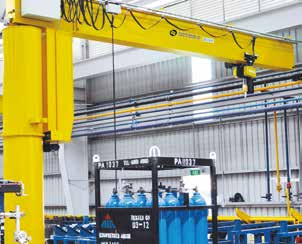
A pillar jib crane is an excellent aid when you need an agile and efficient lifting solution within a limited work area. It is particularly suitable for production facilities, machine shops and service halls where goods or components need to be moved repeatedly over short distances.
What is a pillar jib crane?
A pillar jib crane is a floor-mounted lifting device with a vertical pillar and a horizontal jib that slews on it. The jib rotates around the pillar, typically 270 degrees, and allows the load to be moved over a wide but controlled area.
Applications
A pillar jib crane is best suited for the following situations:
- Workstation lifting: On assembly lines and at workstations where heavy parts or products are handled repeatedly.
- Machine loading and unloading: In machine shops where workpieces are moved into or out of machines.
- Service and repair work: In garages, service halls and repair shops where engines or other heavy parts are lifted.
- Storage and packing: In logistics centres and warehouses where boxes or pallets are lifted onto shelves or for transport.
Space-efficient: Takes up little floor space and works well in confined spaces.
Ease of use: Easy to use, quick to install and often suitable for manual operation without major investment.
Safety: Reduces the need for manual lifting and improves occupational safety.
Versatility: Available in different sizes and capacities, often customisable to the application.
Installation location
As a rule, the only limiting factor is the thickness and strength of the floor. In normal situations, with loads under 1000 kg and outreaches of 6 m, the floor thickness is between 170 and 270 mm. The drilling depth is at least 50 mm shorter than the floor thickness, and anchor sizes are determined by the crane’s load capacity. When considering floor strength, the bolt forces must be examined, as they ultimately determine the size and length of the anchor. Typically, the largest bolt forces remain well below 100 kN. Casting can also be used as an installation method, in which case the floor is opened and an 800 mm thick concrete foundation is cast, on which the installation can be carried out. In this case, the anchor bolts are also embedded in the concrete during casting.


